
How to Know If Counselling Is Right for You
You do not need to be in crisis or have a diagnosis to consider counselling. Therapy can provide support when something feels difficult, keeps repeating, or simply deserves more attention than you have been able to give it on your own.

Published: October 7, 2026
How Do You Know If You Need Counselling?
There is no single test that tells you when it is time to start counselling.
Some people reach out because something specific has happened. Others notice that they have been feeling anxious, overwhelmed, disconnected, unhappy, or stuck for a while without being able to point to one clear reason.
You also do not need to wait until a problem becomes severe. The Centre for Addiction and Mental Health (CAMH) explains that people often seek psychotherapy when difficulties begin interfering with relationships, work, school, daily functioning, or their ability to enjoy life.
Those are important signs, but counselling can also be useful earlier. If something is taking up a lot of emotional energy, affecting how you feel about yourself, or making life harder than you would like it to be, that may be enough reason to explore support.
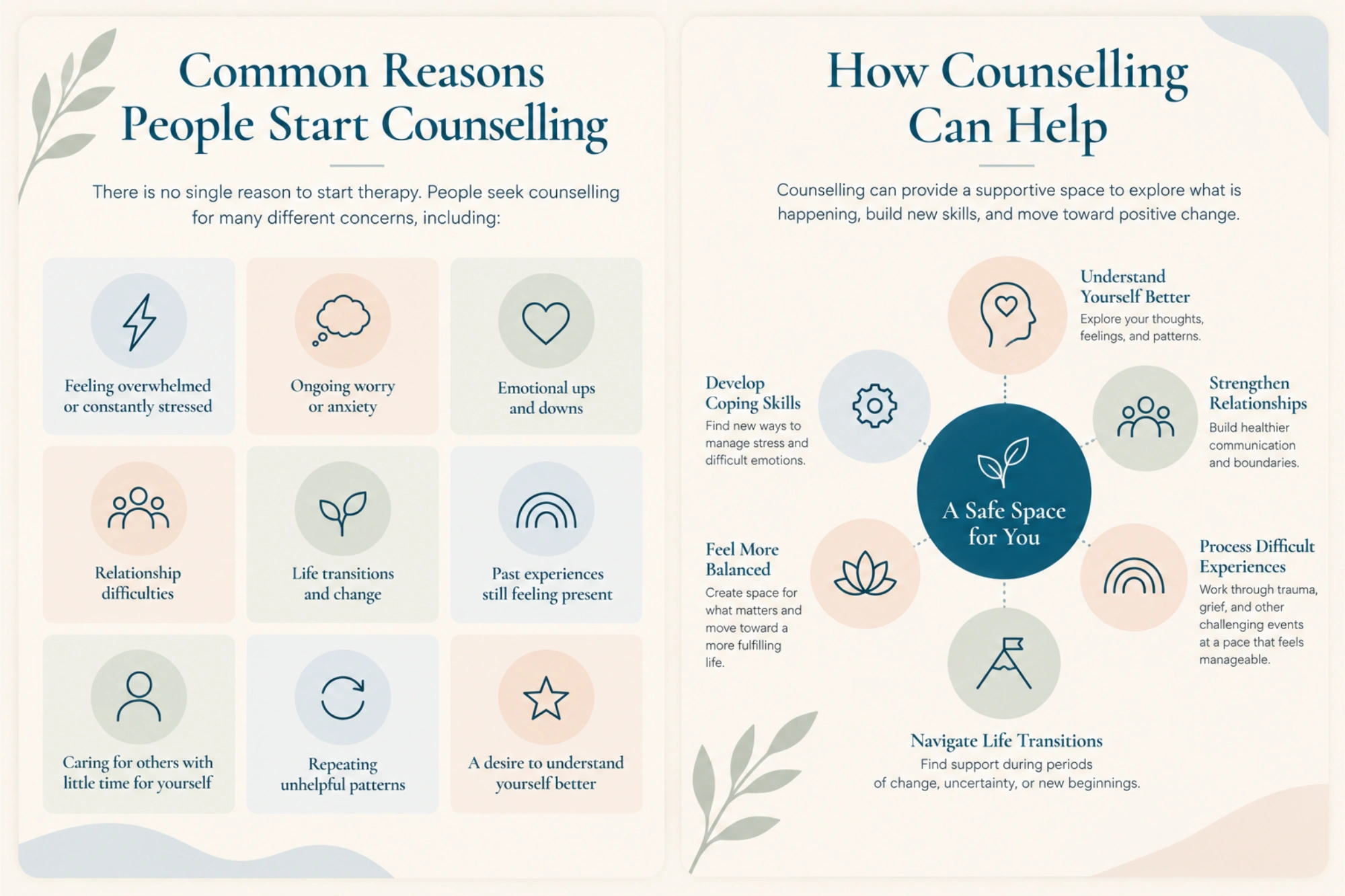
You Do Not Have to Be in Crisis to Go to Therapy
One of the most common misconceptions about counselling is that you should only go when things have become unmanageable.
Therapy can certainly be important during difficult periods, but people also use counselling to better understand themselves, navigate change, strengthen relationships, work on boundaries, process past experiences, or develop healthier ways of responding to stress.
You may be functioning well in many parts of your life while still carrying something that feels difficult internally.
Counselling can provide a dedicated space to pay attention to that experience before it reaches a breaking point.
Signs Counselling May Be Worth Considering
People come to therapy for many different reasons. The following are not a checklist or a diagnosis, but they may help you think about whether counselling could be useful.
You Have Been Feeling Overwhelmed for a While
Stress is part of life, but sometimes it begins to feel as though there is no real opportunity to recover from it.
You might feel mentally overloaded, emotionally exhausted, easily irritated, or constantly behind. Even relatively small problems may start feeling much harder to manage than they normally would.
If you spend most of your time trying to get through the next obligation without much room to recover, counselling may provide space to understand what is contributing to that pressure and what could change.
You Keep Worrying About the Same Things
Worry can be useful when it helps us prepare or solve a problem. It becomes more difficult when the same concerns continue circulating without leading anywhere.
You may find yourself replaying conversations, imagining what could go wrong, second-guessing decisions, or feeling unable to switch off even when there is nothing you need to do in that moment.
The American Psychological Association includes excessive worry, constantly feeling on edge, and difficulty carrying out everyday activities among reasons someone may consider psychotherapy.
Counselling can help you explore what is driving those patterns and develop ways of responding to worry that feel more manageable.
Your Emotions Feel Harder to Manage
You may notice that sadness, anger, fear, guilt, frustration, or other emotions are becoming more intense or harder to recover from.
Sometimes the concern is not that you are feeling too much, but that you feel very little. Emotional numbness, disconnection, or feeling as though you are moving through life on autopilot can also be reasons to seek support.
Therapy can provide space to understand what your emotions may be communicating rather than simply trying to suppress them.
The Same Relationship Patterns Keep Coming Up
Relationships can reveal patterns that are difficult to see when we are in the middle of them.
You might notice recurring difficulties with:
- Setting or maintaining boundaries
- Saying no without feeling guilty
- Expressing what you need
- Trusting other people
- Avoiding conflict at your own expense
- Feeling responsible for other people’s emotions
- Choosing relationships that leave you feeling unsupported
- Withdrawing when relationships become emotionally difficult
Counselling can give you room to look at these patterns without reducing them to a question of who is right or wrong.
For women who want to explore relationships, boundaries, caregiving, identity, burnout, or changing roles, women’s therapy may provide a useful place to begin.
Something From the Past Still Feels Present
An experience does not need to be recent to continue affecting you.
You may notice that certain situations bring up unusually strong emotions, that memories are difficult to think about, or that earlier experiences continue to shape how safe, trusting, confident, or connected you feel today.
Sometimes the connection is obvious. Other times, you may only notice a pattern without knowing exactly where it came from.
You do not need to decide whether an experience “counts” as trauma before discussing it in therapy. If difficult experiences are continuing to affect you, counselling can begin by exploring what you notice in the present.
You Are Going Through a Major Life Change
Life transitions can be difficult even when the change is wanted.
People may seek counselling while navigating:
- A relationship beginning or ending
- Marriage or separation
- Parenthood or changes in parenting
- Children leaving home
- Career changes or retirement
- Moving or relocating
- Illness or changes in health
- Becoming a caregiver
- Bereavement and grief
- Changes in identity, priorities, or sense of purpose
Transitions can bring several emotions at the same time. You can be excited about a change and still grieve what came before it.
Therapy can provide space to make sense of those competing feelings without assuming that one of them must be wrong.
You Are Supporting Everyone Else but Have Little Space for Yourself
It can become easy to organize life around what other people need, particularly when you are caring for children, aging parents, a partner, family members, or people at work.
You may become very capable at handling responsibilities while becoming less aware of how tired, resentful, lonely, or depleted you feel yourself.
Counselling creates a space where the focus can return to your experience.
You do not have to prove that your responsibilities are unusually difficult before wanting support with the impact they are having on you.
Your Usual Ways of Coping Are Not Helping Like They Used To
People develop many ways of managing difficult emotions. Some are intentional, while others become habits over time.
You may notice yourself avoiding situations, withdrawing from people, staying constantly busy, scrolling for long periods, relying more heavily on alcohol or other substances, overworking, overeating, undereating, or distracting yourself whenever uncomfortable feelings appear.
These behaviours may make sense as attempts to cope, even when they eventually create other problems.
Therapy can help you understand what a coping strategy is doing for you and explore alternatives rather than simply judging the behaviour.
You Feel Stuck Even Though You Understand the Problem
Insight does not always create change on its own.
You may already understand why you behave a certain way, know that a relationship pattern is unhealthy, or recognize that you are being too hard on yourself. That does not necessarily make the pattern easy to change.
Counselling can help move from knowing something intellectually to experimenting with different ways of responding in everyday life.
You Want to Understand Yourself Better
Therapy does not always need to begin with a problem that needs to be “fixed.”
You may simply want to better understand your emotions, relationships, values, needs, identity, or the experiences that have shaped you.
Self-understanding can also make it easier to notice patterns sooner and make decisions that feel more aligned with what matters to you.
Is My Problem Serious Enough for Counselling?
You do not need to measure your experience against someone else’s before deciding whether you deserve support.
There will almost always be someone experiencing something that appears more serious. That does not make your own concerns irrelevant.
A more useful question may be:
Is this affecting me enough that I would like some help with it?
If the answer is yes, it is reasonable to explore counselling.
CAMH describes psychotherapy as a form of treatment intended to reduce distress, change unhelpful behaviours or patterns, and support more adaptive ways of coping. It can be used for immediate problems as well as more longstanding or complex concerns.
You do not need to wait for your situation to fit a specific level of severity.
Do You Need a Mental Health Diagnosis to Start Counselling?
No. A diagnosis is not required simply to want a space to talk, reflect, and work on something that is affecting your life.
People seek individual counselling for concerns ranging from stress, grief, self-confidence, relationships, and life transitions to anxiety, trauma-related concerns, and longer-standing emotional patterns.
If there are symptoms that require assessment, diagnosis, medication, or another form of health care, your therapist can also discuss whether another professional should be involved.
Counselling does not have to be the only kind of support you receive.
What If You Cannot Explain What Is Wrong?
You do not need a clear explanation before making an appointment.
“I don’t feel like myself lately.”
“Everything seems harder than it should.”
“Nothing is obviously wrong, but I don’t feel okay.”
“I keep doing the same thing and I don’t know why.”
Any of those can be enough to start a conversation.
A therapist can ask questions, help identify patterns, and gradually build a clearer picture with you. The first session does not require you to summarize your entire life or explain your emotions perfectly.
If uncertainty about the process is making it difficult to reach out, the frequently asked questions cover practical details about online therapy, consultations, appointments, privacy, and what it is like to work together.
What If You Usually Handle Things on Your Own?
Being independent and seeking counselling are not opposites.
You may have successfully managed difficult situations by yourself for years. Therapy does not mean giving up that ability or handing decisions over to someone else.
A therapist’s role is not to take control of your life. Counselling is collaborative. You remain the person making decisions about what you want to discuss, what matters to you, and what changes you want to make.
Sometimes an outside perspective is useful precisely because you have already spent a great deal of time thinking about the situation on your own.
What If Talking About Things Makes Them Feel Worse?
It is possible for difficult emotions to come up during counselling, especially when you begin discussing something you have avoided or carried privately for a long time.
That does not mean therapy should involve pushing you to disclose everything immediately.
CAMH emphasizes the importance of a supportive, comfortable relationship with a therapist, while the APA describes psychotherapy as a collaborative process in which the client and therapist establish goals and work together at an appropriate pace.
You can tell your therapist when something feels too difficult, when you need to slow down, or when you are not ready to discuss a particular experience.
If traumatic or distressing experiences are part of what has brought you to counselling, trauma-focused therapy can also involve preparation, grounding, emotional regulation, and understanding trauma responses before more direct processing is considered.
How Do You Know If a Therapist Is the Right Fit?
Deciding to try counselling is only part of the process. The relationship with the therapist matters too.
You do not need to feel completely comfortable sharing personal information with a stranger immediately, but over the first few sessions you should begin to get a sense of whether you feel respected, heard, and able to be honest.
CAMH identifies the quality of the relationship between therapist and client as an important part of successful psychotherapy and recommends asking prospective therapists about their training, experience, approach, and experience with the concern you want to address.
Questions you may want to ask include:
- What experience do you have with the concerns I am bringing?
- What does your approach to counselling usually look like?
- How do we decide what to focus on?
- How will we know whether therapy is helping?
- What happens if an approach does not feel helpful to me?
- How frequently do you normally meet with clients?
Fit is not about finding someone who agrees with you about everything. It is about finding a therapist with whom you can build enough trust to do useful work together.
How Can You Tell If Counselling Is Helping?
Progress in therapy is not always dramatic or immediate.
Sometimes improvement looks like a symptom becoming less intense. Other times it may mean recognizing a pattern sooner, recovering more quickly after a difficult situation, setting a boundary you previously avoided, understanding an emotion differently, or making a decision with more confidence.
At the beginning of therapy, it can be useful to identify a few things you hope will be different.
For example:
- I want to spend less time worrying about things I cannot control.
- I want to understand why certain situations affect me so strongly.
- I want to communicate my needs more clearly.
- I want to stop feeling responsible for everyone around me.
- I want to feel less controlled by something that happened in the past.
- I want to feel more like myself again.
CAMH recommends discussing treatment goals with your therapist and revisiting how things are going over time. If you are unsure whether therapy is helping, that uncertainty itself is something you can bring into the session.
Does Starting Counselling Mean You Have to Continue Long Term?
No.
Some people use counselling for support with a specific situation or transition. Others work on concerns that have developed over many years and choose to continue for longer.
The appropriate length of therapy depends on your goals, what you are working on, the therapeutic approach, and what you find useful.
You can also reassess along the way. Beginning counselling is not a commitment to attend indefinitely.
When Might You Need More Immediate Support?
Routine counselling appointments are not a substitute for emergency or crisis care.
If you are in immediate danger, call 911 or go to the nearest emergency department.
If you are thinking about suicide, are worried that you may not be able to stay safe, or are concerned about someone else, Canada’s 9-8-8 Suicide Crisis Helpline is available 24 hours a day by calling or texting 9-8-8.
You can use crisis support even if you are unsure how serious the situation is.
What If You Are Still Unsure About Counselling?
You do not need to be certain before having an initial conversation.
You may decide after a consultation that you would like to begin therapy. You may also decide that you want a different therapist, another form of support, or more time before making a decision.
An initial consultation can help you understand what counselling may look like without requiring you to commit to ongoing sessions.
If you are considering one-on-one support, you can learn more about individual counselling, explore women’s therapy, review the online therapy FAQs, or get in touch with questions before booking.
There Is No Perfect Time to Start Therapy
You may never reach a moment when you feel completely certain that counselling is the right choice.
You may wonder whether your concerns are significant enough, whether you should be able to handle them yourself, or whether talking about them will actually make a difference.
Those questions are normal.
Counselling may be worth exploring when something is affecting your well-being, relationships, daily life, or sense of yourself and you would like support understanding or changing it.
You do not need a diagnosis, a crisis, or a perfectly defined goal. You only need somewhere to begin.
Wondering If Therapy Could Help?
An initial consultation gives you space to talk about what has been happening, ask questions about counselling, and explore whether working together feels like a good fit.
You Do Not Need to Have It All Figured Out
Starting counselling does not require a diagnosis, a crisis, or a perfectly defined goal. An initial consultation can help you talk through what has been bringing you here and decide whether therapy feels like a useful next step.