
Trauma-Focused Therapy vs. EMDR Therapy
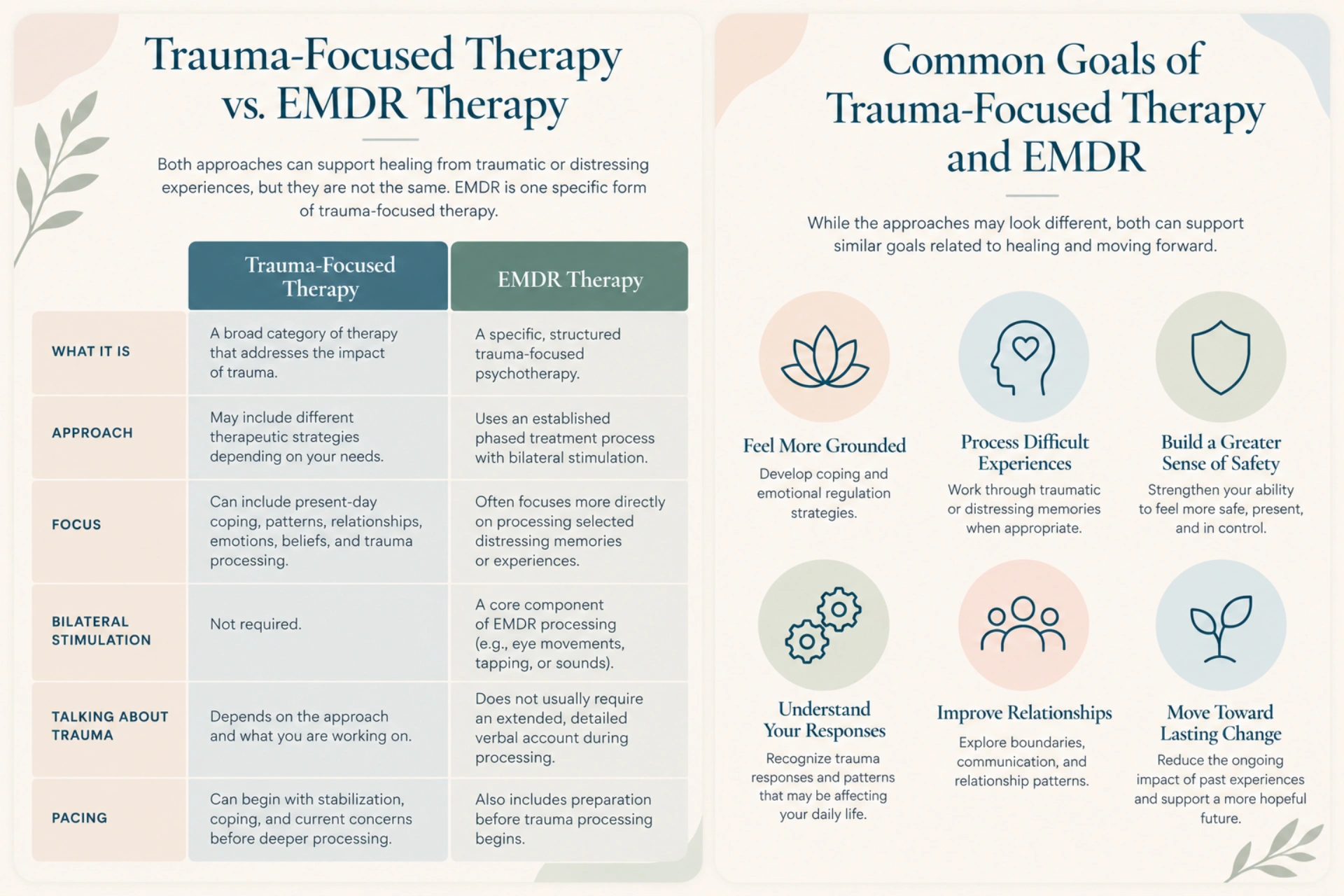
Trauma-focused therapy and EMDR can both support people affected by difficult or traumatic experiences, but they are not two completely separate categories of treatment. EMDR is one specific form of trauma-focused psychotherapy, while trauma-focused therapy can include a broader range of approaches depending on your needs, goals, and readiness.

Published: October 5, 2026
Is EMDR the Same as Trauma-Focused Therapy?
Not exactly, but the two are closely related.
Trauma-focused therapy is a broad term for psychotherapy that directly considers the impact of traumatic or distressing experiences. Depending on the therapist, the client, and the treatment being used, trauma-focused work may involve understanding trauma responses, developing coping and emotional regulation skills, exploring beliefs and patterns connected to past experiences, or directly processing traumatic memories.
EMDR, or Eye Movement Desensitization and Reprocessing, is a specific, structured form of trauma-focused psychotherapy. It follows an established treatment process and uses bilateral stimulation, such as guided eye movements, alternating tapping, or sounds, while working with selected memories or experiences.
The U.S. National Center for PTSD defines trauma-focused psychotherapy as treatment that uses cognitive, emotional, or behavioural techniques to process a traumatic event, with the trauma itself forming a central part of therapy. Its clinical guidance identifies EMDR as one of several evidence-based trauma-focused treatments for PTSD.
So, rather than thinking of trauma-focused therapy and EMDR as opposites, it can be more useful to think of EMDR therapy as one possible way of doing trauma-focused work.
What Is Trauma-Focused Therapy?
Trauma-focused therapy looks at how difficult, frightening, overwhelming, or unsafe experiences may continue to affect your emotions, beliefs, relationships, body responses, coping patterns, and everyday life.
It does not necessarily mean beginning therapy by immediately revisiting traumatic memories in detail.
Depending on your needs, trauma-focused therapy may begin by helping you:
- Understand common trauma responses
- Recognize emotional or situational triggers
- Develop grounding and emotional regulation strategies
- Build a greater sense of safety and stability
- Explore boundaries and relationship patterns
- Understand beliefs about yourself that developed through difficult experiences
- Work with grief, shame, anger, fear, or self-blame
- Process particular experiences when you are ready
The exact process varies because “trauma-focused therapy” can describe more than one therapeutic method.
For PTSD specifically, clinical guidelines recognize several structured trauma-focused psychotherapies. The National Center for PTSD identifies Cognitive Processing Therapy (CPT), Prolonged Exposure (PE), and EMDR among the trauma-focused treatments with the strongest research support.
What Is EMDR Therapy?
EMDR is a more defined therapeutic approach with a structured sequence of treatment phases.
During EMDR, you may focus briefly on aspects of a distressing memory, including an image, thought, belief, emotion, or physical sensation, while engaging in bilateral stimulation.
Bilateral stimulation usually involves sensory input that moves back and forth between the two sides, such as:
- Guided side-to-side eye movements
- Alternating tapping
- Alternating auditory tones
The American Psychological Association’s overview of EMDR describes it as a structured psychotherapy focused on helping people process distressing traumatic memories.
EMDR includes more than bilateral stimulation. Treatment also involves learning about your history, preparing for processing, identifying appropriate memories or themes to work on, monitoring what happens during processing, closing sessions carefully, and reviewing progress over time.
You can learn more about the complete approach on the online EMDR therapy page.
What Is the Main Difference Between Trauma-Focused Therapy and EMDR?
The biggest difference is specificity and structure.
Trauma-focused therapy is a broader category. Sessions may draw from different therapeutic strategies depending on what you need and where you are in the process.
EMDR is a specific therapeutic method with an established protocol and a particular way of working with distressing memories.
| Trauma-Focused Therapy | EMDR Therapy | |
|---|---|---|
| What it is: | A broad category of therapy addressing the impact of trauma | A specific structured trauma-focused psychotherapy |
| Structure: | Varies depending on the therapeutic approach and your needs | Uses an established phased treatment process |
| Primary focus: | May include present-day coping, patterns, relationships, emotions, beliefs, and trauma processing | Often focuses more directly on processing selected distressing memories or experiences |
| Bilateral stimulation: | Not required | A core component of EMDR processing |
| Talking about the trauma: | Depends on the approach and what you are working on | Does not usually require an extended, detailed verbal account during processing |
| Pacing: | Can begin with stabilization, coping, and current concerns before deeper processing | Also includes preparation before trauma processing begins |
These differences do not mean that one approach is inherently gentler, deeper, or more effective than the other. What matters is how the therapy is delivered, what you are working on, and whether the approach fits your individual needs.
Do You Have to Talk About Trauma in Detail?
This is one of the most common concerns people have when considering trauma therapy.
The answer depends partly on the type of therapy being used.
Some trauma-focused approaches involve talking more directly about what happened, examining trauma-related beliefs, or gradually revisiting traumatic memories. Others may place more emphasis on present-day emotions, relationships, coping patterns, or stabilization before direct processing takes place.
EMDR works somewhat differently. You still need to share enough information for your therapist to understand your concerns and plan treatment safely, but EMDR generally does not require an extended verbal retelling of every detail of a traumatic event during processing.
The American Psychological Association notes that EMDR differs from several other trauma-focused treatments because it does not rely on extended exposure, detailed descriptions of the trauma, challenging beliefs, or homework assignments in the same way.
Regardless of the approach, you do not need to disclose everything at once. Therapy can begin with what feels manageable.
Does Trauma-Focused Therapy Always Involve Processing Memories?
No. Trauma processing may eventually become part of the work, but it is not necessarily where therapy begins.
For some people, the most useful starting point is understanding why certain situations trigger strong emotions or why patterns such as withdrawing, people-pleasing, feeling constantly alert, or having difficulty trusting others have developed.
Early trauma-focused work may involve:
- Grounding and coping strategies
- Emotional regulation
- Understanding trauma responses
- Building boundaries
- Strengthening current supports
- Working with shame or self-blame
- Identifying what helps you feel safer and more present
More direct trauma processing can be considered when it is appropriate and when you and your therapist have had time to prepare.
This gradual, individualized approach is part of how online trauma-focused therapy may be structured.
Does EMDR Begin With Trauma Processing Right Away?
No. EMDR includes preparation before reprocessing specific memories.
The therapy follows several phases that include history-taking, treatment planning, preparation, assessment, processing, closure, and reevaluation.
Before beginning bilateral stimulation with a distressing memory, your therapist needs to understand what you are experiencing, what you hope to work on, and whether EMDR is appropriate at that point in therapy.
Preparation may also include strategies to help you manage distress and return your attention to the present.
The National Institute for Health and Care Excellence (NICE) describes EMDR for PTSD as a phased treatment that includes psychoeducation, managing distressing memories and situations, identifying target memories, bilateral stimulation, and strategies for managing flashbacks and emotional distress.
Is EMDR More Effective Than Other Trauma-Focused Therapy?
There is not a simple answer showing that one trauma-focused approach is best for everyone.
EMDR has a strong research base for PTSD, as do several other structured trauma-focused psychotherapies.
The VA/DoD clinical guidance summarized by the National Center for PTSD strongly recommends several individual trauma-focused psychotherapies for PTSD, including EMDR, Cognitive Processing Therapy, and Prolonged Exposure.
The National Center for PTSD also notes that there has not been enough high-quality head-to-head evidence to conclude that EMDR is clearly more effective than other established trauma-focused treatments.
NICE similarly recommends both trauma-focused cognitive behavioural therapies and EMDR for adults with PTSD in appropriate circumstances.
For someone choosing therapy, this means the question is usually less about finding the universally “best” method and more about finding an evidence-informed approach that fits your concerns, preferences, readiness, and relationship with the therapist.
When Might Trauma-Focused Therapy Be a Helpful Starting Point?
A broader trauma-focused approach may make sense when you know that difficult experiences are affecting you but you are not yet sure which memories or events need to be processed directly.
It may also be helpful when the concerns you want to work on extend beyond one particular memory.
For example, you may notice:
- Difficulty trusting people or feeling secure in relationships
- Strong emotional reactions that are difficult to understand
- Feeling disconnected, numb, or constantly on guard
- Shame, guilt, or self-blame
- Difficulty setting or maintaining boundaries
- Patterns of avoiding conflict or prioritizing other people’s needs
- Grief connected to difficult experiences
- A desire to better understand how the past is influencing your life now
Trauma-focused therapy allows these concerns to be explored without requiring you to decide in advance that a particular trauma-processing method is what you need.
When Might EMDR Be Considered?
EMDR may be considered when distressing experiences or memories continue to trigger significant emotional reactions and a more structured memory-processing approach is appropriate.
It may be particularly relevant when you can identify an experience, image, belief, or pattern that continues to feel emotionally charged even though you know intellectually that the event is in the past.
EMDR has been studied most extensively in relation to PTSD. The National Center for PTSD describes EMDR as one of the most studied trauma-focused psychotherapies for PTSD and notes that it is strongly recommended in several major clinical practice guidelines.
That does not mean you need to diagnose yourself with PTSD before asking about EMDR. A therapist can help determine whether the approach is appropriate based on what you are experiencing.
Can Trauma-Focused Therapy Include EMDR Later?
Yes. These approaches do not always have to be chosen as separate paths at the beginning of therapy.
You might begin with broader trauma-focused work and later decide with your therapist that EMDR could be useful for a particular experience or pattern.
For example, early sessions may focus on understanding your reactions, strengthening coping strategies, exploring relationships or boundaries, and building enough stability to consider deeper processing.
EMDR may then become one part of the therapy when it makes sense clinically.
Likewise, completing EMDR does not mean every concern must be addressed through EMDR. Therapy may move between different areas of focus as your goals and needs change.
What if You Are Not Ready to Process Trauma?
You can still go to therapy.
Being affected by trauma does not mean you must be ready to revisit a particular memory.
You may want support with sleep, relationships, anxiety, boundaries, grief, emotional regulation, self-worth, or simply understanding why you have been feeling the way you do.
Those concerns can be meaningful places to begin.
A trauma-informed therapist should be able to talk with you about pacing and explain why a particular form of processing is or is not being considered.
If you are unsure whether you want trauma-specific treatment at all, individual counselling can provide a broader space to explore what is happening without choosing EMDR or another trauma-focused method in advance.
Can Trauma-Focused Therapy and EMDR Be Done Online?
Yes. Both trauma-focused psychotherapy and EMDR can be delivered virtually when online care is appropriate for the client’s circumstances and needs.
Online sessions still require consideration of privacy, emotional safety, technology, and what will happen if a session is interrupted.
For EMDR specifically, bilateral stimulation can be adapted for virtual care using options such as visual eye movements, guided self-tapping, or auditory tones.
If you are considering EMDR virtually, the article EMDR Therapy Online: Common Questions Answered explains the practical side of online EMDR in more detail.
How Do You Decide Between Trauma-Focused Therapy and EMDR?
You do not need to make the decision based on a checklist or choose a therapy method before your first appointment.
Some useful questions to explore with a therapist include:
- What is affecting me most right now?
- Am I looking to work on a particular memory or a broader pattern?
- How comfortable do I feel focusing directly on traumatic experiences?
- Would I benefit from spending time on coping, grounding, or emotional regulation first?
- Do I prefer a highly structured therapeutic approach?
- What evidence supports the options being recommended for my concerns?
- What does the therapist have training and experience providing?
Your preferences matter too. Shared decision-making is an important part of trauma treatment. The goal is not simply to place you into a treatment protocol, but to understand your concerns, discuss appropriate options, and make decisions collaboratively.
What if You Do Not Know Whether Your Experiences Count as Trauma?
You do not need to settle that question before seeking support.
Some people come to therapy because of a clearly identifiable traumatic event. Others begin because they notice anxiety, grief, shame, relationship difficulties, emotional triggers, self-protective patterns, or a sense that earlier experiences continue to influence them.
The word “trauma” can be useful, but it does not have to become a test you need to pass before your experiences deserve attention.
You can begin by talking about what is happening now and what you would like help with. From there, you and your therapist can explore whether trauma-focused therapy, EMDR therapy, or broader individual counselling feels like the most useful place to start.
Choosing a Starting Point for Trauma Therapy
The difference between trauma-focused therapy and EMDR is not that one deals with trauma while the other does not. EMDR is itself a trauma-focused psychotherapy. The difference is that EMDR is a particular structured method, while trauma-focused therapy can describe a broader range of work addressing the effects of traumatic or distressing experiences.
You also do not have to stay with one approach indefinitely. Therapy can begin with stabilization and understanding, move into more focused processing when appropriate, and continue to change as your needs change.
If you are unsure where to begin, an initial consultation can be used to discuss what you have been experiencing, what you hope therapy will help with, and which options may fit your needs.
Not Sure Which Approach Fits?
You do not need to choose a type of trauma therapy before reaching out. An initial consultation can help you discuss what you are experiencing and explore which approach may be appropriate for you.
Find a Starting Point That Feels Manageable
Trauma therapy does not have to begin with the most difficult part of your story. An initial consultation is an opportunity to ask questions, discuss your goals, and explore whether trauma-focused therapy, EMDR, or broader counselling may be the right place to begin.