
What to Expect From Online Therapy in Ontario
Online therapy offers a way to meet with a therapist from a private space using secure video sessions. If you have never tried virtual counselling before, knowing how appointments work, what you need to prepare, and what to expect from your first few sessions can make getting started feel more straightforward.

Published: October 5, 2026
What Is Online Therapy?
Online therapy is psychotherapy or counselling provided remotely using technology such as secure video conferencing. Instead of travelling to a therapist’s office, you attend your appointment from a private location using a computer, tablet, or other device with video and audio.
The conversation itself can look very similar to an in-person therapy session. You and your therapist can talk about what has been happening in your life, explore emotions and patterns, work through difficult experiences, develop coping strategies, and revisit your goals as therapy progresses.
The Centre for Addiction and Mental Health (CAMH) describes virtual mental health care as clinical interaction between clients and health providers using communication technologies such as video or audio. The goal is still to provide safe, effective, person-centred care; the main difference is how you and your provider connect.
Online therapy may be particularly convenient if travelling to appointments is difficult, you live far from the therapist you would like to work with, or you simply feel more comfortable attending from your own space.
How Does Online Therapy Work in Ontario?
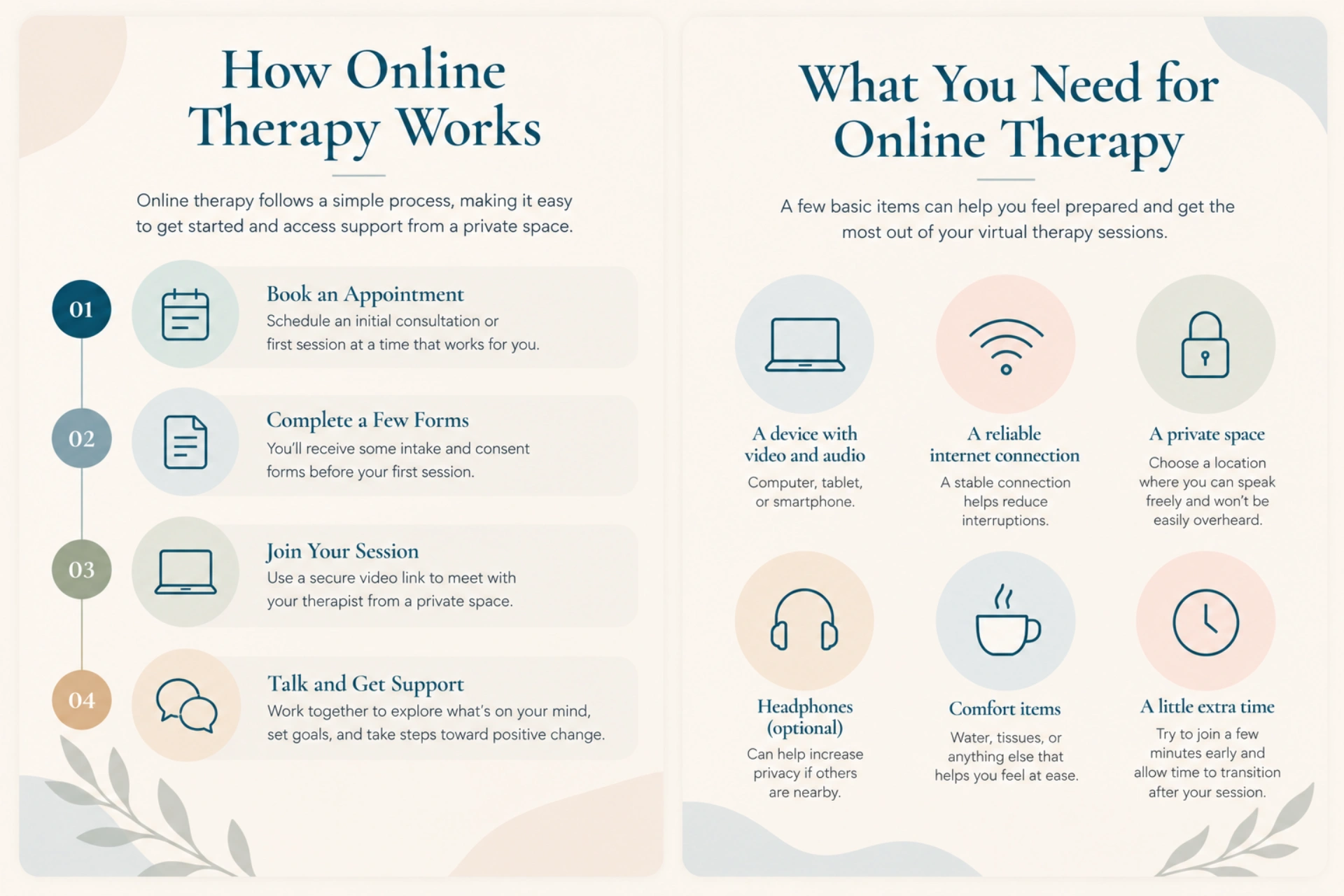
Most private online therapy follows a relatively simple process. Although every practice operates a little differently, you can generally expect to:
- Find a therapist who works with clients in Ontario. Review their qualifications, areas of focus, approach, fees, and availability.
- Book a consultation or first appointment. Some therapists offer a brief consultation before ongoing sessions begin.
- Complete any required forms. These may include intake information, consent forms, privacy information, and practice policies.
- Receive a secure link or client portal access. This is normally where you join your virtual appointment.
- Attend your session from a private space. You and your therapist meet by video and work together much as you would during an in-person appointment.
If you decide to work with Donna, the website’s online therapy FAQs explain the booking process, virtual platform, fees, privacy, and other practical details about the practice.
What Happens Before Your First Online Therapy Session?
Before ongoing therapy begins, you will usually receive information about the therapist’s practice and be asked to review or complete some paperwork.
This may cover topics such as:
- Your contact and basic personal information
- What has brought you to therapy
- Relevant health or mental health history
- Consent to treatment
- Privacy and confidentiality
- How electronic communication and virtual sessions are handled
- Fees, payment, receipts, and cancellation policies
- What to do if technology fails during a session
- How emergencies or urgent concerns are handled
You do not need to write your entire life story in an intake form. The purpose is to give your therapist enough information to begin understanding your situation and to make sure you understand how the practice works.
Ontario professional standards also require regulated practitioners providing virtual services to address considerations specific to electronic practice. For registered social workers, the Ontario College of Social Workers and Social Service Workers’ Standards of Practice include requirements related to confidentiality, privacy, client safety, and planning for service interruptions.
What Happens During an Initial Consultation?
An initial consultation is usually different from a full therapy session. Its purpose is to help you and the therapist get a basic sense of what you are looking for and whether working together may be appropriate.
You might talk about what prompted you to reach out, the concerns you would like support with, what you hope may change, and any previous experiences you have had with therapy.
It is also your opportunity to ask questions. For example, you might want to know:
- What experience does the therapist have with the concerns I am bringing?
- What does their approach to therapy look like?
- How often would we normally meet?
- How are online sessions conducted?
- How does the therapist approach privacy and confidentiality?
- What happens if I am not sure what kind of therapy I need?
You do not need to decide immediately that you want to continue. Fit matters in therapy, and the consultation can help you decide whether the therapist’s approach, communication style, and practice feel comfortable enough to take the next step.
What Should You Expect From Your First Therapy Session?
Your first full session will usually focus on getting to know you more thoroughly and understanding what has been happening in your life.
Your therapist may ask about current concerns, important relationships, major life experiences, stressors, coping strategies, your support system, and what you would like to work toward.
You are not expected to explain everything perfectly. Many people begin therapy knowing that something feels difficult without having a clear explanation for why.
You also do not have to discuss your most painful experiences immediately. Therapy can begin with what feels most relevant and manageable, and the conversation can develop over time.
If you are looking for broad one-on-one support, you can learn more about online individual counselling in Ontario, including the kinds of concerns that may be explored in counselling.
What Do You Actually Talk About in Online Therapy?
There is no required list of topics. What you talk about depends on why you came to therapy and what feels important at that point in your life.
People may use therapy to explore concerns such as:
- Stress or feeling emotionally overwhelmed
- Anxiety or persistent worry
- Low mood or loss of motivation
- Grief and loss
- Relationship difficulties
- Family dynamics
- Traumatic or distressing experiences
- Life transitions
- Burnout and caregiving responsibilities
- Self-esteem, identity, or confidence
- Boundaries and communication
- Patterns that seem difficult to change
Some sessions may focus on something that happened recently. Others may involve looking more closely at experiences from the past or noticing patterns that keep showing up in the present.
Therapy is collaborative. You can tell your therapist when something feels important, when you want to spend more time on a particular issue, or when an approach does not feel helpful.
What If You Do Not Know What to Say?
You do not need to arrive with a prepared agenda.
It is common to know that you want support while still feeling unsure where to begin. You might start with what happened during the week, something you have been thinking about repeatedly, an emotion that has been difficult to understand, or simply the fact that you are not sure what to talk about.
Your therapist can ask questions and help organize the conversation. Silence, uncertainty, and needing time to think are also normal parts of therapy.
You are not being graded on how well you explain yourself. Part of the work can be finding language for experiences that have previously felt difficult to put into words.
What Do You Need for an Online Therapy Appointment?
The technical setup for virtual counselling is usually simple. In most cases, you will need:
- A computer, tablet, or other device with a camera and microphone
- A reliable internet connection
- Access to the therapist’s secure video platform
- A reasonably private place where you can talk openly
Headphones can be useful if other people are nearby, although they are not always necessary.
Try to choose a location where you are unlikely to be interrupted. Letting other people in your household know that you need privacy, silencing notifications, and closing unrelated tabs or applications can make it easier to focus on the session.
It can also help to have water nearby and leave yourself a few minutes before the appointment rather than joining immediately after another demanding task.
How Private Is Online Therapy?
Confidentiality still applies when therapy takes place virtually, but online care introduces some additional privacy considerations.
Ontario’s Information and Privacy Commissioner explains that Ontario health privacy law applies to virtual health care just as it does to in-person care. Providers must consider the privacy and security of personal health information when using virtual technologies and should explain relevant risks and safeguards to clients.
Your own environment matters too. Even when the technology itself is secure, privacy can be difficult if someone else can overhear your conversation.
Before starting online therapy, consider:
- Who may be able to hear you from nearby rooms
- Whether headphones would make the conversation more private
- Whether you are using a private rather than shared device
- Whether notifications or smart devices could interrupt the session
- Where you feel most comfortable having a personal conversation
Your therapist should also explain how records, messages, forms, and virtual appointments are handled within their practice.
Is Online Therapy Effective?
Online psychotherapy is not simply an informal conversation over video. It can be used to deliver established therapeutic approaches with a regulated mental health professional.
Research varies depending on the type of therapy and the concern being treated, but a growing evidence base supports therapist-guided remote psychological care for a number of mental health concerns.
For example, a 2024 systematic review and meta-analysis published in CMAJ examined 54 randomized controlled trials involving 5,463 participants and compared therapist-guided remote cognitive behavioural therapy with in-person CBT. The review found little to no difference in effectiveness between the two delivery formats across the conditions studied.
That does not mean online therapy and in-person therapy are identical or that virtual care is the best option for every person. The quality of the therapeutic relationship, the approach being used, your needs, your environment, and your comfort with technology can all affect the experience.
Is Online Therapy Right for Everyone?
No. Virtual therapy can work well for many people, but there are situations where another type or level of support may be more appropriate.
Online therapy may be more difficult if you do not have a private place to attend, your internet access is unreliable, being on video creates a significant barrier, or your current circumstances require a type of assessment, monitoring, or immediate support that cannot be provided safely through routine virtual appointments.
The Information and Privacy Commissioner of Ontario notes that providers should consider whether a virtual visit is appropriate based on the client’s needs, technical requirements, purpose of the appointment, and the risks and benefits of virtual care.
This is something you can discuss during a consultation. You do not need to determine on your own whether virtual therapy is clinically appropriate before reaching out.
How Do You Know if an Online Therapist Is Regulated in Ontario?
When looking for therapy, it is useful to understand the professional designation of the person you are considering working with.
Regulated mental health professionals are accountable to their respective professional colleges and must meet standards related to professional conduct, confidentiality, documentation, competence, and other aspects of practice.
Donna is a Registered Social Worker with the Ontario College of Social Workers and Social Service Workers. The College maintains a public Online Register where you can confirm whether an Ontario social worker is registered and view information such as registration status and discipline history.
Checking the appropriate regulatory college is a useful step whenever you are considering working with a new regulated mental health professional.
How Often Do Online Therapy Sessions Happen?
There is no schedule that works for everyone.
Some people attend therapy weekly, while others may meet less frequently. How often you meet can depend on what you are working on, the approach being used, your availability, your budget, and what feels helpful over time.
Your therapist can discuss frequency with you when you begin and revisit it as your needs change.
Therapy also does not have to continue indefinitely. Some people seek focused support during a particular period of their lives, while others find value in longer-term work involving patterns, relationships, trauma, identity, or personal growth.
Do You Need a Diagnosis to Start Online Therapy?
No. You do not need to have a formal mental health diagnosis or be experiencing a crisis to want support.
You may decide to start counselling because you feel overwhelmed, stuck, disconnected, exhausted, unsure about a relationship, affected by something that happened in the past, or interested in understanding yourself more clearly.
Therapy can also be useful when things look manageable from the outside but require more effort internally than you would like.
If you are unsure whether your concerns are “serious enough” for counselling, you can still ask. The FAQ page answers additional questions about fit, services, and getting started with online therapy.
What Should You Look for Before Booking an Online Therapist?
Credentials are important, but they are not the only thing worth considering.
Before booking, look at the therapist’s:
- Professional registration and qualifications
- Experience with the concerns you want support with
- Therapeutic approaches or areas of focus
- Fees and payment policies
- Availability and session format
- Approach to privacy and virtual care
- Communication style and overall tone
You may also want to check your extended health benefits before beginning therapy. Coverage can vary depending on your insurance plan and the professional designation of the therapist, so it is useful to confirm directly with your insurer what documentation or credentials are required for reimbursement.
Most importantly, consider whether you feel able to speak openly with the therapist. A provider can have the right qualifications on paper and still not feel like the right personal fit.
How Can You Prepare for Your First Online Therapy Session?
You do not need to do extensive preparation. A few practical steps are usually enough:
- Test your camera, microphone, and internet connection
- Choose the most private space available to you
- Join the session a few minutes early if the platform is unfamiliar
- Keep any questions you want to ask nearby
- Bring water, tissues, or anything else that helps you feel comfortable
- Give yourself some transition time afterward when possible
You can also think briefly about what prompted you to reach out and what you hope may be different as a result of therapy. You do not need a polished answer. Even something as simple as “I have been feeling overwhelmed and I am not sure why” is enough to begin a conversation.
What If You Decide Online Therapy Is Not the Right Fit?
Trying a consultation does not obligate you to continue.
You may decide that you would prefer in-person therapy, want a therapist with a different specialty, need a different appointment format, or simply do not feel that the therapeutic fit is right.
That is useful information. Finding appropriate support sometimes involves speaking with more than one provider before settling on the right option.
If you need help locating other mental health or community services in Ontario, the provincial government’s Find Mental Health Support page lists public, community, crisis, and referral resources available across the province.
Getting Started With Online Therapy in Ontario
If you have been considering therapy but feel unsure about what happens after you reach out, you do not need to have the process figured out in advance.
An initial consultation is an opportunity to explain what has been bringing you to therapy, learn more about the therapist’s approach, ask practical questions, and decide whether virtual care feels comfortable for you.
If you would like to explore one-on-one support, you can learn more about individual counselling, review answers to common questions on the online therapy FAQ, or get in touch if you have a question before booking.
Thinking About Starting Therapy?
An initial consultation gives you a chance to ask questions, talk about what you are looking for, and explore whether online therapy feels like the right fit for you.
Take the First Step Toward Online Therapy
You do not need to have everything figured out before reaching out. An initial consultation can help you discuss what has been bringing you to therapy, ask questions about the process, and decide whether working together feels like a good next step.