
Online Therapy for Women Navigating Life Transitions
Life transitions can change more than your circumstances. They can affect your relationships, routines, responsibilities, identity, and sense of what comes next. Online therapy can provide space to understand those changes, work through difficult emotions, and adjust at a pace that feels manageable.

Published: October 10, 2026
What Is a Life Transition?
A life transition is a period of meaningful change that requires you to adjust to something different. Sometimes the change is sudden. Other times, it develops gradually as your circumstances, relationships, responsibilities, or priorities shift.
Life transitions can include experiences such as:
- Starting or ending a relationship
- Marriage, separation, or divorce
- Becoming a parent
- Changes in parenting as children grow
- Children leaving home
- Becoming a caregiver for a parent, partner, or family member
- Grief and bereavement
- Changes in health or physical ability
- Starting a new career, changing jobs, or retiring
- Relocating or building a life in a new community
- Changes in friendships or family relationships
- Reconsidering your identity, priorities, or sense of purpose
Some transitions are expected and planned. Others arrive without warning. Many contain a mixture of both wanted and unwanted change.
The Centre for Addiction and Mental Health (CAMH) notes that major life changes are a common source of stress and that this can include positive events, such as marriage or a promotion, as well as difficult experiences such as relationship breakdown, illness, financial concerns, or bereavement.
The fact that a change is positive does not mean adjusting to it will always feel easy.
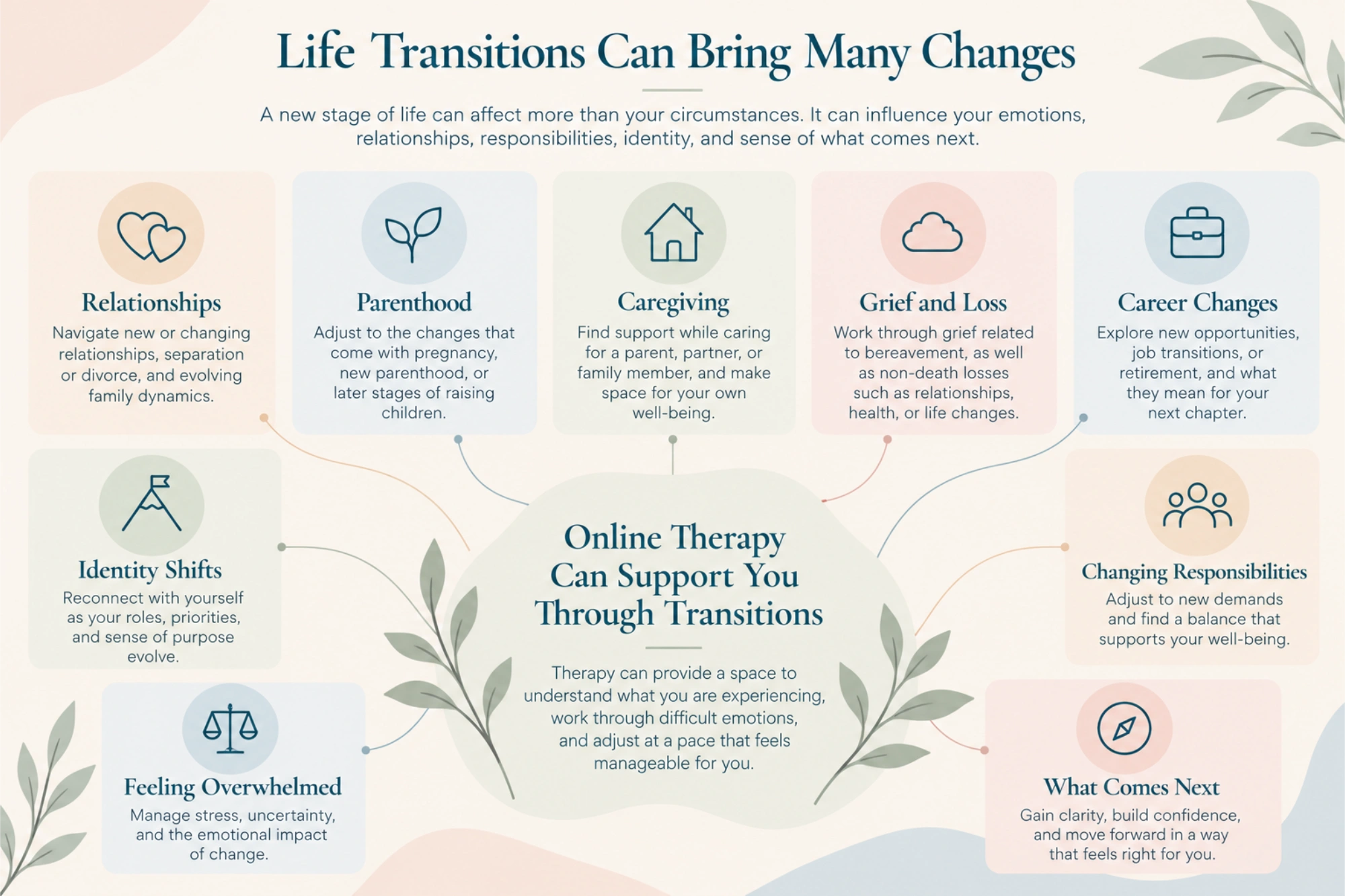
Why Can Life Transitions Feel So Difficult?
Change creates uncertainty. Even when you chose the change yourself, you may still be leaving behind routines, roles, relationships, expectations, or parts of your identity that once felt familiar.
During a transition, you may find yourself trying to understand two things at once: what is ending and what is beginning.
This can bring up emotions that seem contradictory. You might feel relieved and sad after leaving a relationship. You might be excited about becoming a parent while grieving the independence you had before. You might look forward to retirement while feeling uncertain about who you are without your career.
These emotions do not cancel each other out.
The American Psychological Association’s discussion of anxiety during major life transitions highlights the role uncertainty can play when people are moving into an unfamiliar stage of life. A transition may involve genuine opportunities while also raising questions about what will happen, how you will cope, and whether life will feel stable again.
Life Transitions Can Affect Your Sense of Identity
Many major transitions involve more than a change in schedule or circumstances. They can change the way you understand yourself.
You may have spent years thinking of yourself primarily as a parent, partner, professional, caregiver, daughter, or problem-solver. When one of those roles changes, you may find yourself wondering what remains underneath it.
Questions such as these can begin to surface:
- Who am I now?
- What do I want at this stage of my life?
- Which parts of my old life still fit?
- What am I ready to leave behind?
- Why do I feel lost when this change was supposed to be positive?
- What matters to me outside of the roles I have been filling?
This kind of uncertainty is not unusual. Canadian Virtual Hospice’s MyGrief.ca resources describe how changes involving caregiving, relationships, loss, health, work, and other roles can affect a person’s sense of identity as well as their day-to-day life.
Women’s therapy can provide space to explore those identity shifts without requiring you to immediately decide what the next version of your life should look like.
Relationships Can Change During Major Life Transitions
When your life changes, your relationships often change with it.
A new job may alter how much time you have for friends or family. Parenthood can affect a partnership in ways you did not anticipate. Caregiving can shift a parent-child relationship. Separation can change friendships and family dynamics as well as the relationship itself.
You may also begin noticing that relationships which made sense during one stage of your life no longer feel the same.
Therapy may help you explore:
- How your needs are changing
- Communication during periods of stress
- Boundaries with partners, family members, friends, or colleagues
- Feelings of guilt about disappointing other people
- Changes in closeness, intimacy, or trust
- How much responsibility you take for other people’s emotions
- Which relationships feel supportive during the transition
The purpose is not necessarily to preserve every relationship exactly as it was. Sometimes adjusting to a new stage of life also means learning how you want to relate to the people around you now.
Parenthood Can Be Both Meaningful and Disorienting
Becoming a parent can bring love, meaning, and connection while also changing nearly every part of daily life.
Your time, sleep, relationships, priorities, work, body, independence, and sense of identity may all shift at once.
Later stages of parenting can bring different transitions. Returning to work, raising teenagers, co-parenting, becoming a single parent, supporting adult children, or adjusting when children leave home can all raise new emotional questions.
You may find yourself thinking:
- I love my family, but I do not feel like myself anymore.
- I feel guilty whenever I need time for myself.
- My relationship has changed since becoming a parent.
- I am not sure what I need outside of caring for everyone else.
- My children need me differently now, and I do not know what my role is supposed to be.
These experiences do not mean you are ungrateful or failing at parenthood. They may simply reflect how significant the transition has been.
Caregiving Can Gradually Reshape Your Life
Not every life transition has a clear beginning.
Caregiving often develops gradually. You may start by helping a parent with appointments or errands, then find yourself coordinating health care, managing emergencies, making difficult decisions, or providing increasingly frequent emotional and practical support.
The Ontario Caregiver Organization identifies concerns such as exhaustion, difficulty sleeping, feeling trapped, inability to relax, loss of hope, and changes in eating as possible signs of caregiver burnout.
Caregiving can also raise more complicated emotions, including guilt, anger, resentment, grief, fear, and loneliness.
Its SCALE caregiver support program specifically addresses themes such as burnout, guilt, helplessness, difficult emotions, boundaries, isolation, and the question, “Who am I aside from being a caregiver?”
If caregiving has come to dominate your time or identity, counselling can provide a space where the conversation is centred on you rather than only on the needs of the person you care for.
Grief Can Be Part of Transitions That Do Not Involve a Death
Grief is often associated with bereavement, but meaningful loss can happen in many other circumstances.
You may grieve:
- The end of a relationship
- A friendship that has changed
- Your previous health or physical abilities
- A career or professional identity
- A home or community you have left
- A future you expected to have
- The independence you had before becoming a caregiver
- A version of yourself that no longer feels accessible
MyGrief.ca describes non-death losses as potentially significant sources of grief, including separation, divorce, changes in identity or roles, illness, career changes, retirement, relocation, financial losses, and the loss of hopes or future plans.
These forms of grief can be especially difficult when the people around you do not recognize that anything has been lost.
Therapy can make room for both sides of a transition: what you are moving toward and what you may still need to grieve.
Career Changes Can Affect More Than Your Work
A career can provide income, but it may also provide routine, social connection, confidence, status, purpose, and a sense of identity.
That means professional changes can have emotional effects even when the change appears positive from the outside.
You may be:
- Beginning a more demanding role
- Leaving a career that no longer feels right
- Returning to work after raising children or caregiving
- Starting over professionally later in life
- Dealing with job loss or instability
- Approaching retirement
- Questioning whether success still means what it once did
A transition like this can bring practical decisions alongside deeper questions about identity, values, confidence, financial security, and what you want the next stage of life to include.
Life Transitions Can Expose Burnout That Was Already Building
Sometimes the transition itself is not the only difficulty.
A change can reveal how much you were already carrying.
You might have been managing work, family responsibilities, caregiving, relationships, household tasks, and other people’s needs for years. Then another change happens and there is simply no capacity left to absorb it.
You may notice:
- Feeling emotionally exhausted
- Becoming irritable over small things
- Having difficulty concentrating
- Feeling detached from people or activities you usually care about
- Struggling to rest without feeling guilty
- Feeling as though you are constantly reacting rather than choosing
- Having little sense of what you want for yourself
CAMH notes that prolonged stress can affect sleep, energy, concentration, relationships, work, and daily functioning, particularly when demands feel greater than the resources available to cope with them.
Therapy may help you understand what needs to change rather than simply finding another way to push through.
How Can Therapy Help During a Life Transition?
Therapy cannot remove uncertainty or make every decision for you. It can provide a consistent space to slow the process down and understand what the transition is bringing up.
Depending on what you are experiencing, therapy may help you:
- Identify and understand difficult emotions
- Make sense of changes in identity
- Process grief and loss
- Notice relationship patterns
- Set or strengthen boundaries
- Clarify what matters to you now
- Work through guilt, fear, resentment, or self-doubt
- Develop strategies for managing stress and uncertainty
- Adjust expectations that no longer fit your circumstances
- Make decisions with greater awareness of your own needs and values
You do not need to arrive knowing exactly what the problem is.
If the transition is only one part of what you are dealing with, individual counselling can also provide broader support for stress, relationships, grief, self-confidence, emotional well-being, and patterns that may extend beyond the current change.
Therapy Can Help You Separate What You Want From What Is Expected of You
Transitions often come with expectations.
You may feel pressure to be happy about becoming a parent, relieved after leaving a difficult relationship, grateful to care for a family member, excited about retirement, or confident after receiving a promotion.
Sometimes those expectations make it harder to acknowledge what you are actually feeling.
You might also find yourself making decisions based on what a partner, parent, child, employer, or community expects rather than what feels right for you.
Therapy can provide space to ask questions such as:
- What do I actually want?
- Which expectations belong to me and which have I absorbed from other people?
- What am I afraid will happen if I disappoint someone?
- What would this decision look like if guilt were not making it for me?
- What values do I want to carry into this next stage?
The goal is not to ignore the people who matter to you. It is to make sure your own needs, emotions, and values remain part of the conversation.
What If You Feel Like You Have Lost Yourself?
When your life has revolved around particular roles for a long time, it can be difficult to know what is left when those roles change.
You may have become so accustomed to being needed, productive, responsible, or accommodating that asking what you enjoy or want now feels surprisingly difficult.
Rebuilding a sense of self does not necessarily mean returning to exactly who you were before.
A transition can also become an opportunity to understand what you want to carry forward and what you are ready to approach differently.
This may involve exploring interests, relationships, boundaries, values, creativity, rest, goals, or parts of yourself that received less attention during an earlier stage of life.
What If You Know What Needs to Change but Feel Stuck?
Knowing what would help is not always the same as being able to do it.
You might know that you need stronger boundaries but still feel guilty setting them. You may know that you need more rest but feel unable to stop working. You may recognize that a routine is unsustainable but struggle to replace it with something realistic.
This is one area where therapy and therapy-informed wellness coaching can sometimes overlap.
Wellness-focused work may help connect emotional insight with practical changes involving routines, boundaries, stress management, self-care, values-based goals, and sustainable daily habits.
The focus is not on creating a perfect routine or adding more expectations. It is on identifying small changes that make sense within the life you actually have.
When Is It Worth Seeking Support for a Life Transition?
You do not need to wait until the transition becomes unmanageable.
Counselling may be worth considering if you notice that the change is:
- Taking up a great deal of emotional energy
- Affecting your sleep, concentration, or daily routines
- Creating persistent anxiety or sadness
- Changing how you feel about yourself
- Straining important relationships
- Leaving you feeling isolated or unsupported
- Bringing up difficult past experiences
- Making it difficult to make decisions or move forward
- Contributing to burnout or emotional exhaustion
You might also seek therapy simply because you want a place to think through the transition more intentionally.
If you are unsure whether your concerns are significant enough for counselling, the resource How to Know If Counselling Is Right for You explores that question in more detail.
Why Can Online Therapy Be Helpful During a Transition?
Life transitions often make schedules more complicated rather than less.
You may be balancing work, children, caregiving, appointments, relationship changes, or new responsibilities while also trying to make time for your own well-being.
Online therapy removes travel to and from a therapist’s office and allows you to attend from a private location within Ontario.
This can make counselling easier to incorporate into a changing routine, particularly when time or transportation is limited.
Virtual sessions still require privacy, a reliable internet connection, and a device with video and audio. Online therapy is also not automatically the right format for every person or situation.
If you have not attended virtual counselling before, What to Expect From Online Therapy in Ontario explains how appointments work and what you can expect before your first session.
What Might Therapy for a Life Transition Look Like?
There is no single process because the transition itself is only part of the picture. Your history, relationships, responsibilities, goals, and emotional needs all shape what may be useful.
Sessions may involve:
- Talking through what has changed
- Identifying emotions that have been difficult to name
- Exploring grief for what has been lost
- Understanding patterns that the transition has brought to the surface
- Working on boundaries or communication
- Clarifying your needs and priorities
- Developing strategies for stress or emotional overwhelm
- Exploring identity outside of particular roles
- Considering realistic next steps without pressuring yourself to solve everything immediately
The focus may also change as the transition unfolds. Something that felt most important at the beginning may become less central once your circumstances start to settle.
You Do Not Need to Rush Into the Next Version of Yourself
Periods of transition can create pressure to move forward quickly.
You may feel as though you should already know what you want, have adjusted to the change, stopped grieving what came before, or become comfortable with your new role.
Adjustment rarely follows such a clear timeline.
There can be value in allowing some uncertainty while you learn what this stage of your life actually feels like.
Therapy can provide a place to explore that uncertainty without treating it as something that needs to be fixed immediately.
If you are navigating a transition involving identity, relationships, caregiving, burnout, grief, boundaries, or changing roles, you can learn more about online women’s therapy in Ontario. Broader concerns can also be explored through individual counselling, while wellness coaching within therapy may be useful when you want to connect emotional insight with practical changes in daily life.
Going Through a Period of Change?
Therapy can provide space to focus on what this transition means for you, including the emotions, relationships, responsibilities, and questions that may come with it.
Give Yourself Space to Navigate What Comes Next
You do not need to have a clear plan for the next stage of your life before seeking support. An initial consultation can help you talk through what is changing, what feels difficult, and what you would like more support with.