
What Is Trauma-Informed Therapy?
Trauma-informed therapy recognizes that difficult or overwhelming experiences can influence how safe, trusting, connected, and in control a person feels. Rather than being one specific treatment method, it is an approach to therapy that emphasizes safety, choice, collaboration, and working at a pace that respects the individual.

Published: October 14, 2026
What Does Trauma-Informed Therapy Mean?
Trauma-informed therapy is an approach to care that recognizes how traumatic, overwhelming, or unsafe experiences can affect the way a person feels, responds, relates to others, and experiences the world around them.
It is not one specific therapy technique.
Instead, being trauma-informed influences how therapy is provided. It asks the therapist to consider the possible effects of trauma when building the therapeutic relationship, discussing treatment options, setting goals, introducing difficult topics, and deciding how quickly to move.
The Centre for Addiction and Mental Health (CAMH) describes trauma-informed care as an approach that validates and responds to a person’s unique experience of trauma. It recognizes that emotional, behavioural, and physical responses may have developed as ways of coping with overwhelming experiences rather than simply treating those responses as problems in isolation.
That perspective can change an important question in therapy from “What is wrong with you?” toward “What has happened, how has it affected you, and what would help now?”
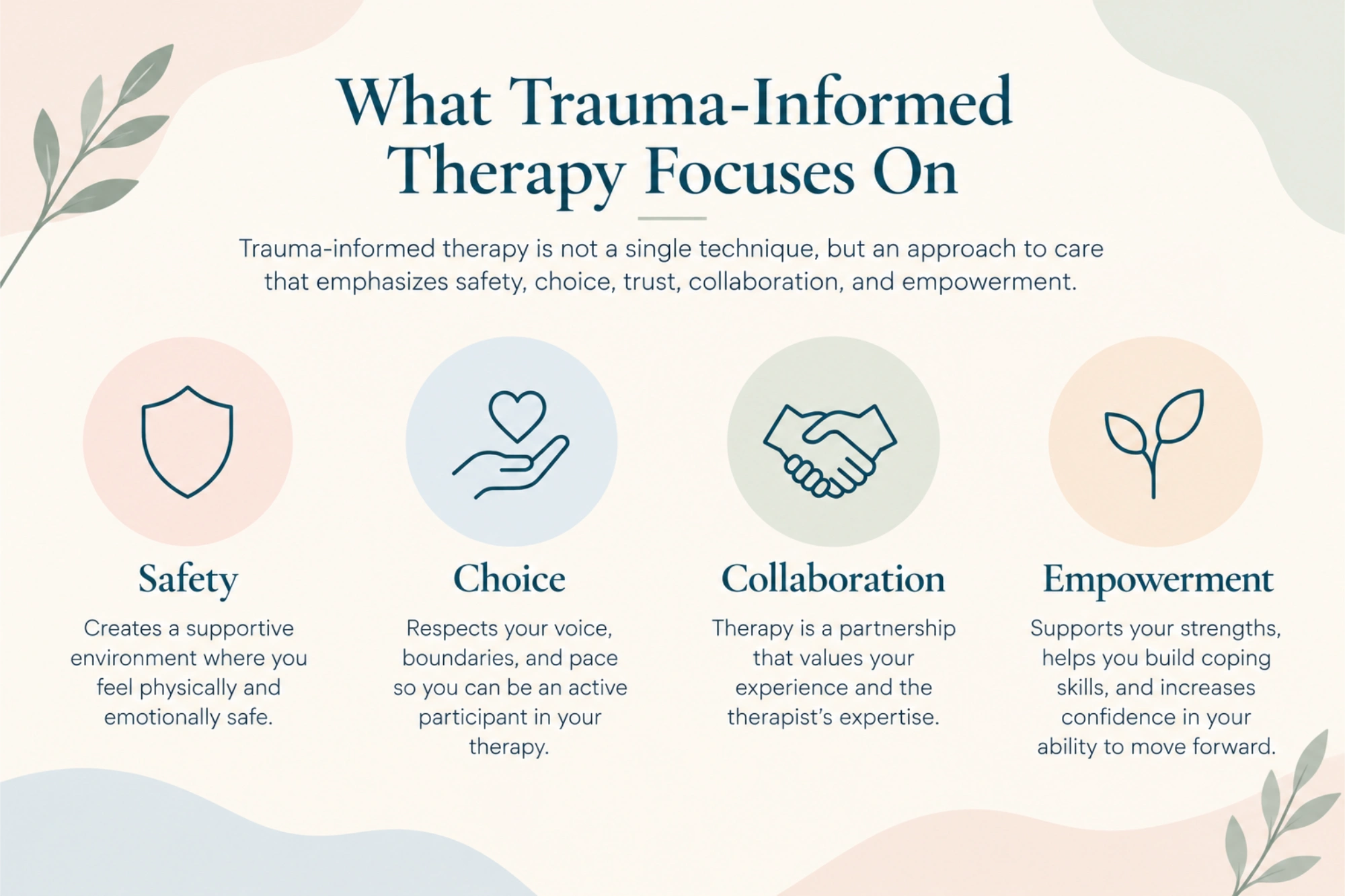
Trauma-Informed Therapy Is an Approach, Not a Single Treatment
The terms “trauma-informed therapy” and “trauma therapy” are sometimes used as though they mean the same thing, but there is an important distinction.
A therapist can work in a trauma-informed way even when trauma is not the primary focus of the session.
For example, you might be seeking counselling for anxiety, boundaries, relationship difficulties, grief, burnout, or a life transition. A trauma-informed therapist may still consider how past experiences could influence your sense of safety, trust, emotional responses, or comfort within the therapy process.
Trauma-focused therapy, by comparison, more directly addresses the effects of traumatic or distressing experiences as part of treatment.
Specific approaches such as EMDR therapy can also be used to process traumatic memories when that type of work is appropriate.
Trauma-informed care provides the broader foundation: attention to safety, choice, trust, collaboration, and the person’s ability to have a meaningful voice in their care.
What Are the Principles of Trauma-Informed Therapy?
Different organizations describe trauma-informed practice somewhat differently, but several principles consistently appear.
The Substance Abuse and Mental Health Services Administration (SAMHSA) identifies six guiding principles of a trauma-informed approach:
- Safety
- Trustworthiness and transparency
- Peer support
- Collaboration and mutuality
- Empowerment, voice, and choice
- Attention to cultural, historical, and gender-related factors
Not every one of these principles will look the same in individual psychotherapy as it does in a hospital, community organization, or other system of care. However, they provide a useful framework for understanding what trauma-informed therapy is intended to feel like.
Safety Comes First
Safety is one of the foundations of trauma-informed care.
This includes physical safety, but it also includes emotional and psychological safety.
During therapy, this may mean knowing:
- What is going to happen during a session
- Why your therapist is suggesting a particular approach
- That you can ask questions
- That you can say when something feels uncomfortable
- That you do not have to disclose everything immediately
- That your boundaries will be taken seriously
- What confidentiality means and where its limits are
The Canadian Trauma-Informed Practice Guide describes safety, trust, choice, empowerment, and connection as central to trauma-informed services.
Feeling safe does not necessarily mean therapy will always feel comfortable. Difficult emotions can still arise. The difference is that discomfort should occur within a process that is thoughtful, transparent, and responsive to what you are experiencing.
Choice and Control Matter
Traumatic experiences frequently involve some form of powerlessness, loss of control, or inability to change what is happening.
Trauma-informed therapy tries not to unnecessarily recreate those dynamics.
You remain an active participant in your own therapy.
This can include having a voice in:
- What you want to work on
- Which goals feel important
- What you are ready to discuss
- Whether a particular therapeutic approach feels appropriate
- When something needs to slow down
- What strategies feel useful or unhelpful
A therapist still brings professional knowledge, asks questions, and may suggest approaches that involve challenging work. Trauma-informed care does not mean that the client must direct every aspect of treatment.
It means decisions are made collaboratively wherever possible rather than therapy feeling like something being done to you.
Trust Is Built Through Transparency
Trust may take time, particularly if past experiences have taught you to be cautious around other people.
A trauma-informed therapist should not expect immediate trust simply because they are a professional.
Instead, trust can develop through consistency and transparency.
That might include clearly explaining:
- How therapy works
- What a particular exercise is intended to do
- Why a difficult topic may be worth exploring
- How information about you is documented and protected
- What the therapist can and cannot provide
- What happens if your needs fall outside their scope of practice
Knowing what to expect can reduce some of the uncertainty that makes therapy feel vulnerable.
Trauma-Informed Therapy Is Collaborative
Therapy involves two forms of expertise.
Your therapist brings education, clinical training, experience, and knowledge of therapeutic approaches. You bring the knowledge of your own experiences, responses, relationships, values, needs, and life.
Trauma-informed therapy recognizes that both matter.
SAMHSA describes collaboration and mutuality as an effort to reduce unnecessary power differences and create meaningful partnership in care.
In practical terms, this may mean your therapist asks what you are noticing rather than assuming they already know, checks how an approach is affecting you, and adjusts the work when something is not helpful.
You Do Not Have to Tell Your Entire Trauma Story
Beginning therapy does not automatically mean describing every difficult experience in detail.
You may need to share enough information for your therapist to understand what is happening, identify important concerns, and determine what kinds of support may be appropriate.
That does not mean everything needs to be disclosed at once.
You might begin with:
- How you have been feeling recently
- Patterns you have been noticing
- Situations that trigger strong reactions
- Relationship difficulties
- Sleep, anxiety, or emotional regulation concerns
- What you would like to feel different
The details of difficult experiences can be explored when they are relevant to therapy and when you are ready to work with them.
If you are seeking broader support without knowing whether trauma processing is something you want, individual counselling can provide space to begin with your current concerns.
Trauma-Informed Therapy Pays Attention to Pacing
Going slowly is not always necessary, but moving at an appropriate pace is.
Some people are ready to work directly with difficult memories relatively early in therapy. Others benefit from spending more time developing coping strategies, understanding trauma responses, strengthening support systems, or building trust in the therapeutic relationship.
The Canadian Trauma-Informed Practice Guide emphasizes supporting people in ways that reduce the possibility of re-traumatization and allow them to learn and grow at a pace that feels safe.
Pacing may involve:
- Breaking difficult topics into manageable pieces
- Checking your level of distress during the session
- Pausing when you become overwhelmed
- Returning attention to the present when needed
- Spending more time on stabilization before trauma processing
- Revisiting the treatment plan as your needs change
The goal is not to avoid every difficult feeling. It is to make sure the therapeutic work remains manageable enough to be useful.
What Does “Avoiding Re-Traumatization” Mean?
Re-traumatization can occur when an experience recreates important aspects of an earlier traumatic experience, such as helplessness, loss of control, humiliation, threat, or having boundaries ignored.
SAMHSA includes actively resisting re-traumatization as a core part of trauma-informed care.
In therapy, reducing this risk may involve paying attention to how questions are asked, how much choice you have, whether consent is ongoing, how difficult material is introduced, and how the therapist responds when you become uncomfortable.
It does not mean that trauma can always be discussed without distress.
Working through painful experiences can bring up difficult emotions. Trauma-informed practice focuses on how that work is approached and whether the person remains supported and involved in the process.
Does Trauma-Informed Therapy Avoid Challenging You?
No.
Trauma-informed does not mean that a therapist will agree with everything you say, avoid difficult subjects, or never encourage you to try something uncomfortable.
Meaningful therapy can involve looking at patterns you would rather avoid, questioning beliefs that no longer serve you, experimenting with different behaviours, or processing painful experiences.
The difference is in how that challenge happens.
A trauma-informed therapist should be able to explain the purpose of the work, consider your readiness, listen when something is not working, and collaborate with you about how to proceed.
There is a difference between productive discomfort and feeling powerless within the therapeutic process.
Does Trauma-Informed Therapy Mean the Therapist Assumes You Have Trauma?
No.
A trauma-informed approach recognizes that trauma is common and that its effects are not always immediately visible. It does not require a therapist to assume that every difficulty comes from trauma.
Stress, grief, relationship concerns, medical issues, social circumstances, personality, current life events, and many other factors can influence emotional well-being.
Trauma-informed care asks the therapist to remain aware of the possible effects of trauma without forcing every experience into a trauma explanation.
That distinction matters because being trauma-informed should increase curiosity and individualization, not replace one rigid explanation with another.
What Are Trauma Responses?
People can respond to overwhelming experiences in many ways.
Some reactions may be obvious, such as intrusive memories, nightmares, fear, or avoiding reminders of what happened.
Other responses can be less immediately recognizable. Someone may become highly alert to other people’s moods, withdraw from relationships, find conflict particularly difficult, disconnect from emotions, struggle with boundaries, or feel a strong need to stay in control.
CAMH notes that trauma-informed approaches understand many emotional, physical, and behavioural adaptations as coping responses that developed in the context of overwhelming stress.
This does not mean that every coping response remains helpful indefinitely.
Therapy can involve recognizing why a response developed while also exploring whether it still serves you now.
What Is the Difference Between Trauma-Informed and Trauma-Focused Therapy?
This distinction can be confusing because the terms sound very similar.
Trauma-informed therapy describes the principles that guide how care is provided. Safety, trust, collaboration, choice, empowerment, and awareness of trauma shape the therapeutic relationship and process.
Trauma-focused therapy more directly addresses traumatic experiences and their ongoing effects as part of treatment.
A therapist can therefore provide trauma-informed counselling without directly processing trauma in every session.
Trauma-focused treatment should also ideally be delivered in a trauma-informed way.
If trauma or distressing experiences are a central concern for you, you can learn more about online trauma-focused therapy in Ontario.
Where Does EMDR Fit Into Trauma-Informed Care?
Eye Movement Desensitization and Reprocessing (EMDR) is a specific structured psychotherapy that may be used to process traumatic or distressing memories.
EMDR and trauma-informed therapy are therefore not interchangeable terms.
EMDR describes a particular therapeutic approach. Trauma-informed care describes the broader principles that influence how therapy is provided.
An EMDR therapist can use trauma-informed principles throughout treatment by taking time for preparation, explaining the process, discussing consent, considering emotional safety, monitoring how you are responding, and adjusting the pace when necessary.
If you are deciding between broader trauma work and EMDR, Trauma-Focused Therapy vs. EMDR Therapy explains the difference between the two approaches in more detail.
What Might a Trauma-Informed First Therapy Session Look Like?
Your first appointment usually does not require immediate trauma processing.
The therapist may begin by learning about:
- What has brought you to counselling
- What is affecting you most right now
- Relevant parts of your history
- Important relationships and supports
- How you currently cope with difficult emotions
- What you hope therapy may help with
- Any concerns you have about the therapy process
You may also discuss practical topics such as confidentiality, boundaries, session frequency, communication outside appointments, and what to expect from online therapy.
The first session is partly about gathering information, but it is also the beginning of the therapeutic relationship.
You can pay attention to whether you feel listened to, whether your questions are taken seriously, and whether the therapist explains their approach in a way that makes sense to you.
What If You Do Not Remember Everything That Happened?
You do not need a complete or perfectly organized memory of your past to seek therapy.
Memory can be affected by many things, and people often remember difficult experiences unevenly.
You may remember certain moments clearly and have little memory of others. You may know that a period of your life was difficult without being able to describe exactly why.
A trauma-informed therapist should not pressure you to fill in gaps or produce memories that are not there.
Therapy can work with what you currently know and what you are experiencing now.
Can Trauma-Informed Therapy Help With Boundaries and Relationships?
Yes. Trauma can affect how people understand safety, closeness, responsibility, trust, conflict, and boundaries.
You may notice patterns such as:
- Agreeing to things you do not want to do
- Feeling guilty when you set a boundary
- Taking responsibility for other people’s emotions
- Avoiding conflict even when something matters to you
- Finding it difficult to trust or depend on other people
- Becoming highly alert to changes in someone’s tone or mood
- Withdrawing when relationships feel emotionally intense
A trauma-informed approach can help explore these patterns with curiosity rather than treating them as character flaws.
The goal may be to understand what a pattern once protected you from and determine whether a different response would serve you better now.
Can Trauma-Informed Therapy Be Provided Online?
Yes. Trauma-informed principles can be applied during virtual counselling as well as in-person therapy.
Online sessions may even provide some people with additional choice over their physical environment because they can attend from a familiar private space.
At the same time, virtual therapy requires its own safety and privacy considerations.
Your therapist may discuss:
- Where you will attend sessions
- Whether anyone else can hear you
- How you will reconnect if the video call fails
- What support is available if significant distress comes up
- How emergency situations would be handled
If virtual counselling is new to you, What to Expect From Online Therapy in Ontario provides a broader overview of the process.
How Can You Tell If a Therapist Is Trauma-Informed?
“Trauma-informed” is a term you may see on many therapist websites, but the label alone does not tell you exactly how someone practises.
It is reasonable to ask questions.
You might ask:
- How does trauma inform your approach to counselling?
- What happens if I feel overwhelmed during a session?
- Do I have to discuss traumatic experiences in detail?
- How do you decide when someone is ready for trauma processing?
- How will I be involved in setting therapy goals?
- What trauma-focused approaches are you trained to provide?
- How do you approach boundaries, consent, and pacing?
The answers should help you understand what trauma-informed care means in that particular practice rather than relying on the term by itself.
Do You Need Trauma-Focused Therapy?
Not everyone with a history of difficult experiences needs or wants formal trauma processing.
You may be primarily looking for help with anxiety, grief, relationships, boundaries, burnout, or another current concern.
A trauma-informed therapist can take your history into account without making trauma the focus of every session.
If past experiences are clearly continuing to affect your daily life, relationships, emotional reactions, or sense of safety, more direct trauma-focused therapy may eventually be useful.
If you are not sure, you do not need to decide before reaching out. Individual counselling can provide a broader place to start while you and your therapist better understand what you need.
Trauma-Informed Therapy Starts With the Person, Not Just the Experience
Trauma-informed therapy recognizes that two people can experience similar events and respond in very different ways.
Your needs cannot be determined solely by what happened to you.
Your strengths, relationships, culture, identity, current circumstances, coping strategies, preferences, and goals all matter too.
That is why trauma-informed care is not simply a collection of techniques. It is a way of approaching the therapeutic relationship that recognizes the effects of trauma while preserving the person’s voice, choice, dignity, and involvement in their own care.
You do not need to arrive ready to tell your entire story. Therapy can begin with what is affecting you now and move from there at a pace that feels manageable.
Looking for Trauma-Informed Support?
An initial consultation gives you space to talk about what you are experiencing, ask questions about the therapy process, and explore an approach that takes your comfort, needs, and readiness into account.
Therapy Can Begin With What Feels Manageable
You do not need to tell your whole story or be ready to process difficult memories before seeking support. An initial consultation can help you discuss what you need now and explore a therapeutic approach that respects your pace and goals.